Create Water: How Our Dear, Righteous Spellcasters Play Alchemist Without Realizing It
By Kash’Shria of Durakiss Science Department
Every morning, our dear priests, druids, or paladins-those paragons of virtue who think they know everything-cast a spell so mundane they forget its magic: a gesture, an incantation, and suddenly, up to three hundred liters of pure water, fresh as morning dew, appear. They use it to drink, wash, cook, as if it were normal. As if it were trivial. But stop for a moment, dear pious readers. Where does this water come from, hmm? Is it a mere sleight of hand, or proof that our humblest spells conceal mysteries so deep they would make an archmage break into a cold sweat?
In our lands, even the driest like Sambrune, water is everywhere: in the air we breathe, in the earth we tread upon, in our very bodies.
How the Consortium define the water?
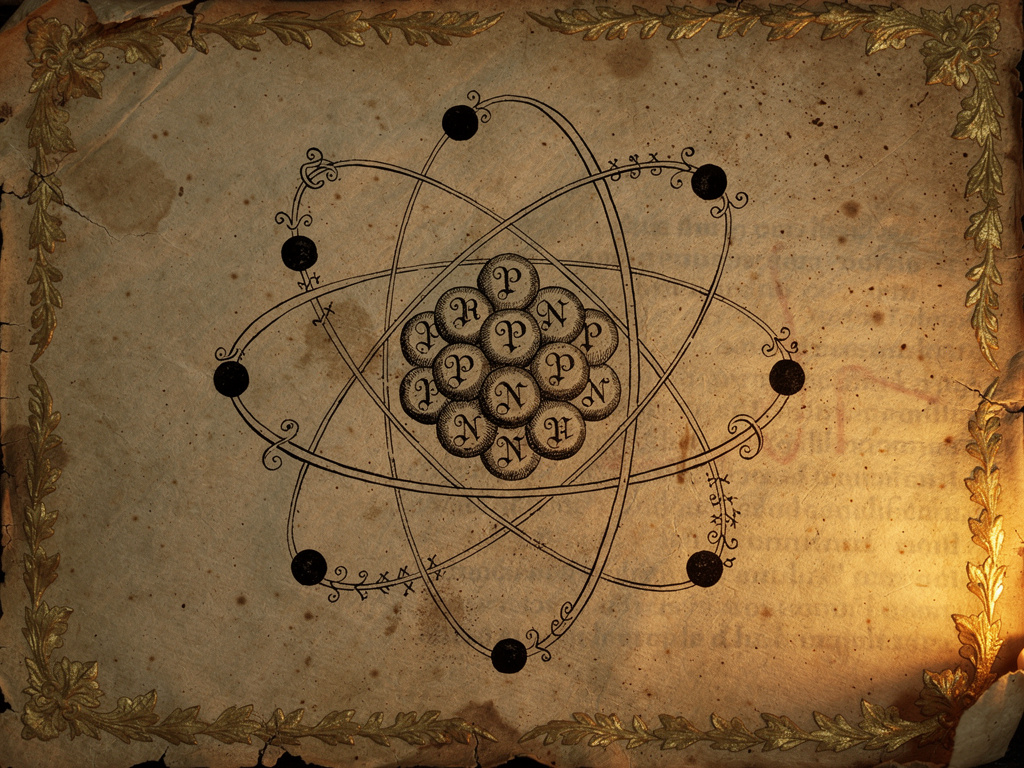
The science that the Consortium deigns to share with us, as if it were doing us a favor-teaches us that this water is made of molecules, themselves composed of atoms: two atoms of hydrogen, the lightest and most mischievous of elements, and one atom of oxygen, the one that keeps us alive. H2O, a sacred formula… or almost as powerful as a spell.
Atoms are the fundamental building blocks of all matter: infinitesimally small particles with a central nucleus (protons and neutrons) orbited by electrons. The Consortium uses that knowledge to build everything, from spacecraft hulls to fuels, as their structure and combinations (molecules) define each material’s properties. Without atoms, nothing would exist – and their ships wouldn’t fly!
So, when a priest casts Create Water, what really happens? Invocation? Pure creation? Atomic alchemy? Let us delve into the arcane secrets of this cantrip and prepare for revelations that, I am certain, will shake the very foundations of their so well-established faith.
Useful reminders about the spell create water
Create Water is a conjuration cantrip, of the Creation subschool, which allows the generation of up to three hundred liters of pure water, like rainwater. This water can appear in a container or as rain within a space three times larger, up to nine hundred liters, for it to fall. The water is always at room temperature-neither frozen nor boiling-and the spell has a range of forty meters.
And here is what makes this spell so interesting: it works even in the most arid desert, where the air’s humidity is nearly nonexistent. A detail which, of course, is of no importance to our dear spellcasters. After all, why ask questions when you can simply believe that everything is as it should be?
The nature of the spell, well-identified exclude that the water comes from the Water Elemental Plane.
But how that can fit with what Atomic Science of Consortium said to us?
First hypothesis: magical condensation
The first hypothesis that comes to mind-even to a mind as sharp as mine-is that of magical condensation. What if the spell merely condensed the humidity in the air? After all, air always contains a bit of water, even in the desert, in the form of vapor. But in an extreme desert, the humidity is far too low to produce three hundred liters. Moreover, the spell works instantly, without waiting for natural condensation. Condensation, you see, requires precise conditions of temperature and pressure, as well as time. A cantrip cannot force three hundred liters to appear as if by magic… unless magic itself alters the laws of physics. But our dear, self-righteous folk would no doubt prefer to ignore this little detail.
Imagine a spell that attracts all the water molecules within a forty-meter radius, like a magnet for H2O. But even then, in the desert, there isn’t enough vapor to fill a bucket, let alone three hundred liters. So unless our dear mages are capable of creating humidity from nothing-which, by the way, would be far more impressive than merely condensing it-this hypothesis doesn’t hold water.
The second hypothesis: ex nihilo creation
The second hypothesis is that of ex nihilo creation-that is, creating water from nothing. The science of the Consortium-always so generous with its explanations-teaches us that matter and energy are one and the same, thanks to the famous equation E=mc² from the illustrious sorcerer Einstein. To create three hundred liters of water, roughly three hundred kilograms, would require a colossal amount of energy. One kilogram of water is equivalent to nine times ten to the sixteenth power joules-an enormous amount of energy. Three hundred kilograms, therefore, is about two point seven times ten to the nineteenth power joules, enough to level an entire region, or even a small kingdom.
Yet a cantrip is a minor spell, of level zero. So how could a low-level mage channel the energy of an apocalypse without being reduced to ashes? It’s like an apprentice sorcerer trying to lift a mountain with a Mage Hand spell. Magic has its limits… or perhaps it draws from a source of energy we do not yet know. But our dear paladins, of course, prefer to believe that everything is simple and safe.
The third hypothesis: atomic transmutation
The third hypothesis is that of atomic transmutation. What if the spell reorganized the atoms already present in the air? Air is composed of seventy-eight percent nitrogen, twenty-one percent oxygen, and one percent other gases, including hydrogen. The water molecule, H2O, consists of two hydrogen atoms and one oxygen atom. The idea, then, would be that the spell breaks down O2 and N2 molecules to extract the oxygen, captures the hydrogen-even in trace amounts-and recombines it all into H2O. Imagine a spell that acts like a mad alchemist: it disassembles the molecules in the air, like a miniature Disintegrate spell, then reassembles them into water. But beware, dear apprentices: breaking atomic bonds is playing with fire, literally. The chemical reaction 2H2 + O2 -> 2H2O is exothermic, meaning it releases energy, like an explosion. Creating three hundred liters of water would release about one point five times ten to the ninth power joules, the equivalent of three hundred kilograms of an explosive far more powerful than gunpowder. Result: an explosion with every Create Water!
So why don’t we see mages exploding when they cast this spell? Either magic neutralizes the energy, or it uses another method. But our dear priests, of course, don’t even ask the question. After all, why doubt when you can simply have faith?
fourth hypothesis: using the proto-matter
There remains a fourth hypothesis, bold and – dare I say – elegantly obvious to any true spellcaster: that so-called « pure water » from Create Water does not hail from the Elemental Plane of Water at all, but from the proto-matter of the Ethereal Plane itself – that raw, malleable essence which permeates the Ethereal like an ancient mist.
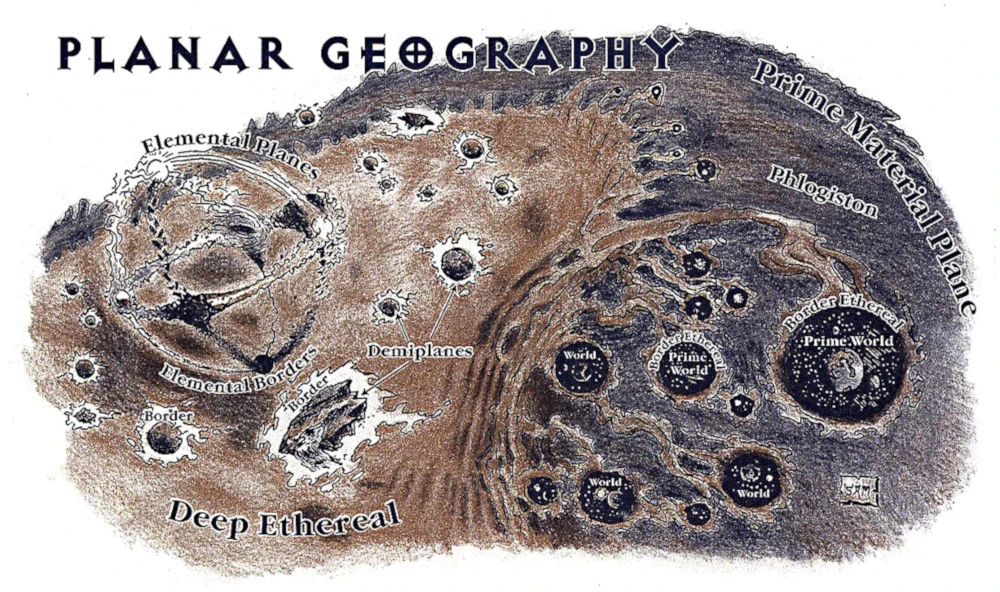
Let’s briefly recall the Great Wheel cosmology – a system so elegantly structured that even the most dull-witted mortal should grasp its design. The universe, naturally, arranges itself in concentric spheres: at its heart, the Prime Material Plane, where material worlds bathe in phlogiston and are girded by crystal spheres, all enveloped by the Ethereal Plane, that misty realm of proto-matter so often bungled by the uninitiated. Beyond this, the Inner Planes form a sphere of such obvious complexity – the six major elements interwoven with para-elemental and quasi-elemental planes. The Astral Plane, of course, connects the Prime Material’s worlds to each other and to the Outer Planes, sixteen planes of alignment circling the Outlands. And then there are the Demiplanes, those isolated fragments within the Ethereal, born of magic or natural caprice, each obeying its own laws – as if the Prime Material touching both Astral and Ethereal, yet these two never deigning to communicate, were not proof enough of the cosmos’ refined order.
Behold: the Ethereal Plane is no mere veil between worlds, but an ocean of pure potential, a primordial soup where matter has yet to choose its form. When a creation spell is cast, magic does not manufacture water – it draws from this proto-matter, as one would from a bottomless well, and imbues it with will to shape it into water or any substance. This is why the water is always pristine: proto-matter, by definition, is untouched by impurity – no dust, no salt, no memory of prior states. Nor are there explosions, for the magic of such spells acts as a filter, absorbing all side effects back into the Ethereal itself, that conveniently invisible realm to the uninitiated.And here’s the delightful part: this theory explains why these spells work everywhere, even in the void of space.
The Ethereal’s proto-matter permeates all, like an underground river flowing beneath every plane, every world, every speck of dust. When you cast Create Water, you are not tapping into a local reservoir – you are reaching into the Ethereal, and magic, that old accomplice, grants your request… without ever revealing its source. Of course, ordinary mortals call it « a spell. » We, the enlightened, know it is simply proto-matter bending to will. As it always does.
What we can thinks about all of this?
At this stage of our reflections, we could ask ourselves if the sub-school « creation » would not be fundamentally misunderstood because misnamed by the majority and the basis of all its spells a use of this reservoir of proto-matter. Which is also the case with Mordenkainen’s Magnificent Mansion. One can also wonder why there is a need for a tiny door for this precise spell. But that’s an article to write.
At that point maybe we can consider that the magic operate at a more fondamental level of physic and rewrite the the reality in another way that atomic science can’t explain. Or perhaps the proto-matter described in our planar cosmogony is what makes up the building blocks of atoms themselves, but this concerns quantum physics, a field about which the consortium has not yet shared its secrets.
So, dear pious readers, the next time you cast Create Water to fill your waterskin, remember: you may hold in your hands proof that magic and science are one and the same or that we lack a general theory explaining both physics and magic.. Whether by drawing from an invisible reservoir, rearranging atoms like an alchemist, or creating matter from energy we cannot measure, one thing is certain: our simplest spells conceal mysteries as deep as the ocean.
In the meantime, I leave you with this thought, dear readers: the next time you drink a glass of water, ask yourself… where does it truly come from? And if the answer displeases you, remember that ignorance is a luxury few can afford. Me? I prefer to know. Even if the truth, sometimes, stings a little.
And what do you think?
This article does not claim to offer a definitive answer. Rather, it aims to open doors, raise questions, and perhaps spark a debate.
If you are interested in magic, science — or whatever may lie somewhere between the two — come and share your thoughts.
You can leave a message for the Gazette at Mur County Center (there is a notice board to the right as you enter), or stop by Durakiss and ask to speak with Kash’Srhia from the Science Department.